

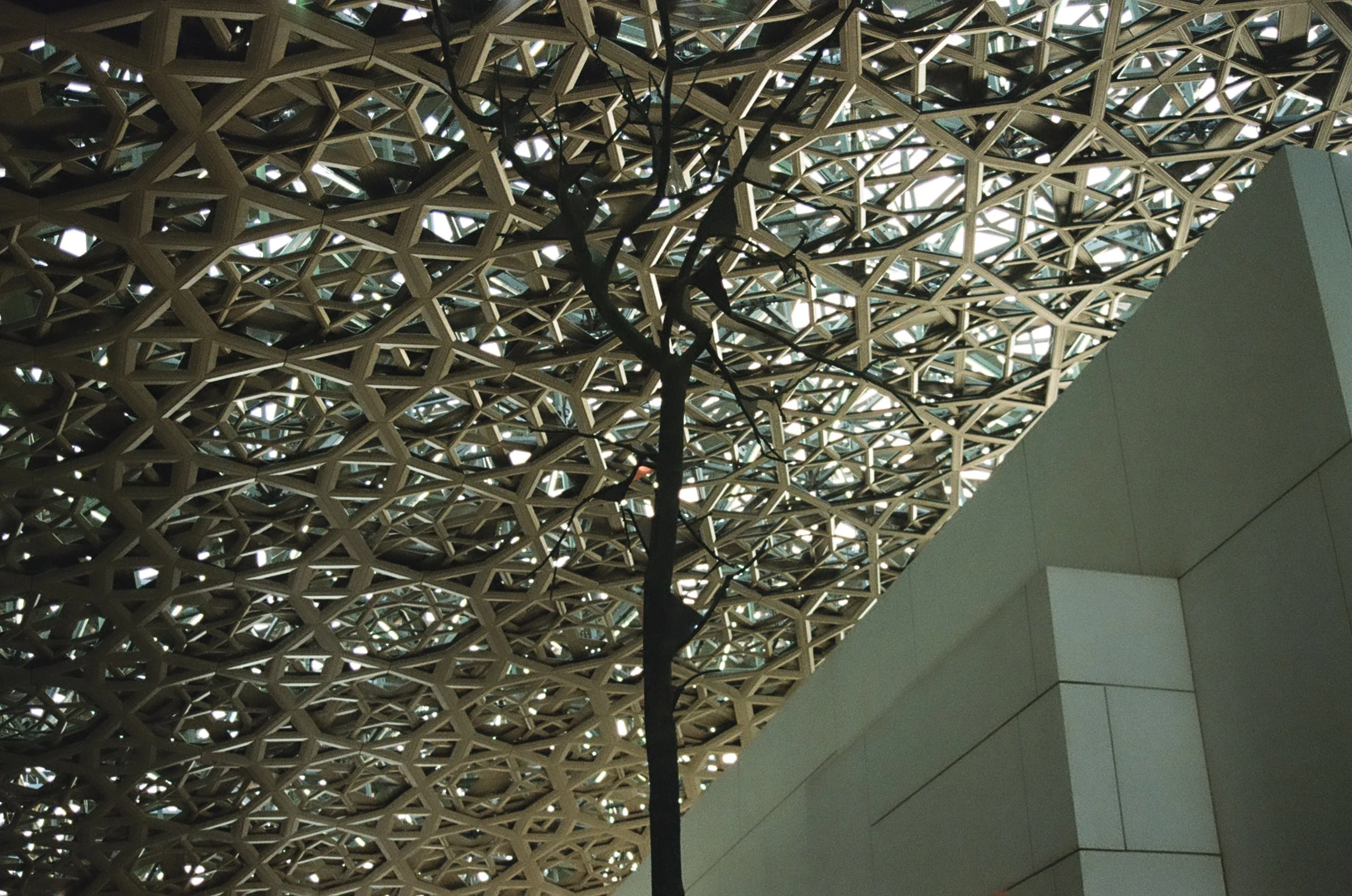
Penone’s Leaves of Light at Louvre Abu Dhabi.
The Inner Flow of Life: Giuseppe Penone in Doha
The Inner Flow of Life is one of this year's not-to-be-missed exhibitions in Doha. Running until February 13, 2027, the exhibition brings together more than 50 works by Italian artist Giuseppe Penone, spanning his practice from 1969 to the present day. On view at the National Museum of Qatar, the works encompass sculpture, drawing, installation and photography, exploring our relationship with nature and the interconnectedness of all living things.
Marking Penone's first solo exhibition in Qatar, the presentation extends beyond the museum's galleries into its central courtyard, where five purpose-built pavilions have been created. Each is dedicated to a material central to the artist's practice: leaves, porcelain, thorns, marble and leather.
Co-curated by Hans Ulrich Obrist, Artistic Director of the Serpentine Galleries, and Issa Al Shirawi, Head of International Exhibitions at Qatar Museums, The Inner Flow of Life traces the evolution of Penone's artistic language, from his early work Rovesciare i propri occhi (Reversing One's Eyes, 1970) to Vene di bronzo (Bronze Veins, 2026).
Giuseppe Penone’s Idee di Pietra Takes Root at Old Doha Port
The exhibition also extends beyond the museum walls. At Old Doha Port, Idee di Pietra (Ideas of Stone, 2010–24) has been permanently installed. The monumental sculpture comprises two bronze trees, their branches holding river stones at various intersections, with additional stones scattered across the ground. Gravity and balance are central to the composition: the weight of the stones appears to challenge the branches that support them, while the trees themselves evoke the slow, continuous process of natural growth.
The work embodies a visualisation of thought. The tree becomes the emergence of an idea, while the stones represent the points of entry, interruptions or obstacles encountered along its course. Like the organic growth of a tree, thought is never static; it remains fluid, evolving and perpetually in motion.

Penone’s Matrice di linfa at Palais d’Iéna, Paris, October 2019.
Nature as Material: The Influence of Arte Povera on Giuseppe Penone
Born in Garessio, near Cuneo in northern Italy, Penone has long drawn inspiration from the forests of his native region. The vegetal and mineral worlds are fundamental to his artistic vocabulary. Beginning his research in the late 1960s, he sought to challenge established conventions and reconsider how we perceive the world around us. His practice is deeply rooted in Arte Povera, which he describes as “a state of mind, not a movement, where there is freedom to use everything”.

Penone’s Matrice di linfa at Palais d’Iéna, Paris, October 2019.

Penone’s Matrice di linfa at Palais d’Iéna, Paris, October 2019.
Trees occupy a central place in Penone's research. His Alberi (Trees) series encapsulates one of his fundamental ideas: that sculpture need not be understood as a fixed, solid object, but rather as something fluid, evolving and continuously transformed. For Penone, fluidity is inherent in the metamorphosis of natural elements, including the human body. Through his work, he brings different scales and rhythms of growth into dialogue: the rapid movement of water, the slower transformations of the human body, the growth of a tree over decades and the formation of stone over millions of years.
This relationship between time, growth and transformation is particularly evident in Alberi Libro (Book Trees) and Respirare l'ombra (To Breathe the Shadow), two works presented in his 2025 retrospective at London's Serpentine Galleries.
In Alberi Libro, the wooden beams of trees, carved to reveal the growth rings concealed within their trunks, make visible the passage of time and the seemingly invisible processes of nature. The tree itself becomes the sculpture, inviting viewers to contemplate its internal structure and the logic of its growth. Surrounding Alberi Libro is Respirare l'ombra, metal cages filled with laurel leaves. Recalling the tree's former foliage, they evoke its past skin and protective covering. The fragrance of the leaves brings another dimension to the experience, drawing nature into the museum and inviting visitors to breathe in its presence. In doing so, Penone encourages an awareness of our own breath and of the natural world that sustains it.
Ultimately, Penone's work is an invitation to recover our capacity for wonder: to look more closely, to be surprised and to recognise aspects of reality that might otherwise go unnoticed. His sculptures remind us that nature is not something separate from ourselves, but an interconnected system of which we are an integral part.
The exhibition arrives at a particularly meaningful moment for Qatar. Beginning in January 2027, the country will celebrate the 16th edition of Years of Culture, the cultural exchange initiative established under the leadership of Sheikha Al Mayassa, with Italy as Qatar's cultural partner for the year. Against this backdrop, The Inner Flow of Life offers a compelling encounter with one of Italy's most influential contemporary artists, while opening up a broader conversation about nature, time and our place within the living world.
MORE ENTITRE


