Where Grandeur meets Ruins - Oscar Niemeyer’s visionary project left on hold forever
How did the ambitious International Fair in Tripoli, commissioned in the 1960s from one of the most celebrated architects of the time, unravel just before completion?
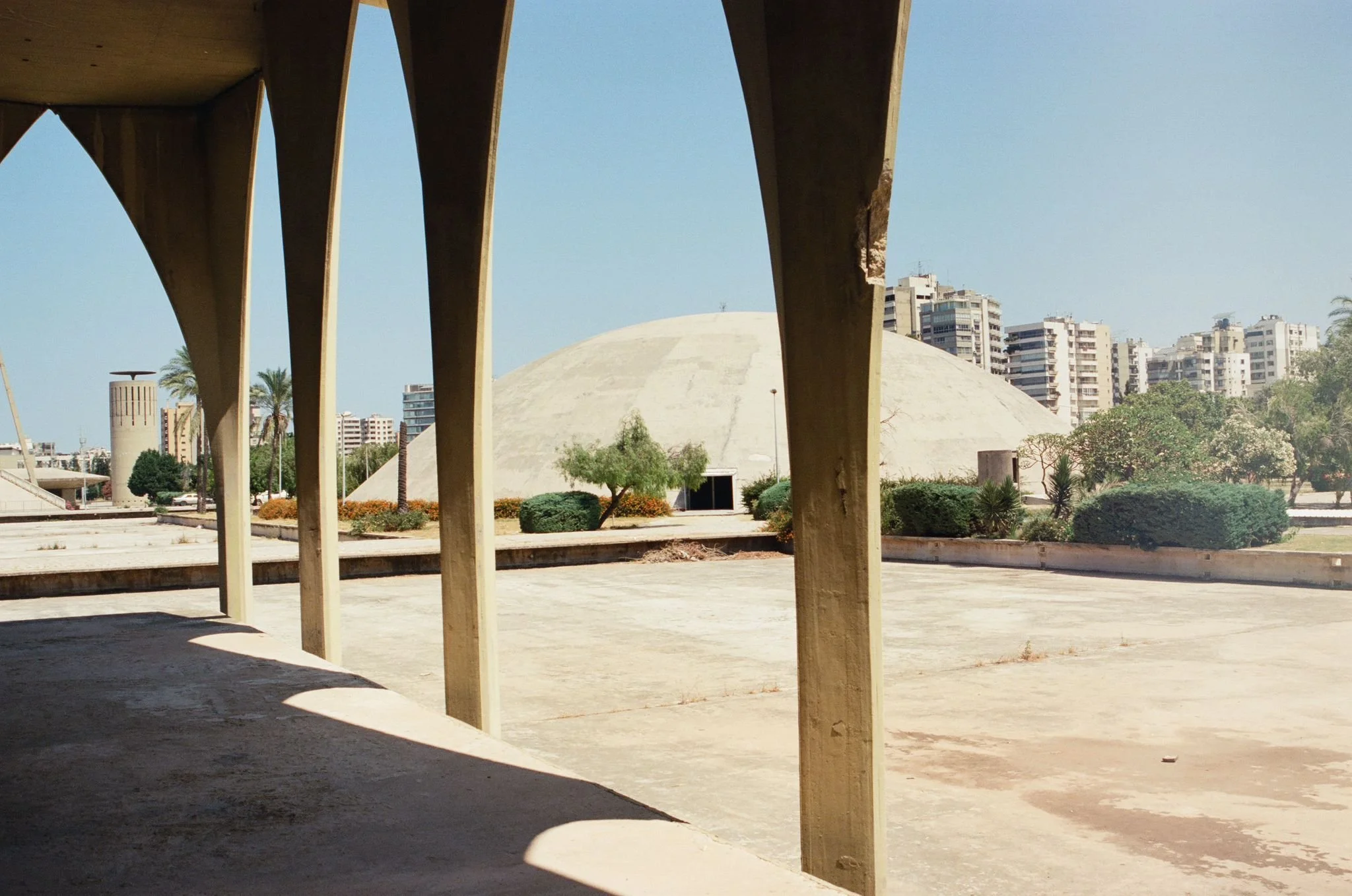
Under the shade of the Lebanese Pavilion arcs.
To put things back in context, in the 1950s, with the liberation of the Lebanese economy, Beirut was attracting most of the country’s capital.
The idea behind the construction of a Permanent International Fair was initiated by President Fouad Chehab in the 1960s, with the intention to resolve the social and territorial inequalities of peripheral areas such as Tripoli and reinforce the sense of unity of the newly independent state.
Thus, in a spirit of decentralisation, Brazilian architect Oscar Niemeyer was chosen to design a bold architectural complex aimed to hoist Tripoli to the rank of a modern metropolis.
View from inside the Lebanese Pavilion.
Designer Pierre Gonalons during his residency in Beirut.
After visiting the site, his first intention was for the Fair site to become the city’s third hub by connecting the city’s historical centre to the Al Mina port area.
Niemeyer envisioned a continuous open space from the seafront up - that was supposed to be occupied by residential, commercial and tourist facilites, with the International Fair in the background.
Oscar Niemeyer’s initial proposal - a hub connecting the historical city centre to the seafront and port area.
The projet soon hit a first wall when the government rejected the idea of connecting the site to the seafront, which was in total contradiction with the initial idea to open up the city.
A view of the elliptical site of the International Fair, cut off from the seafront and the historical city centre.
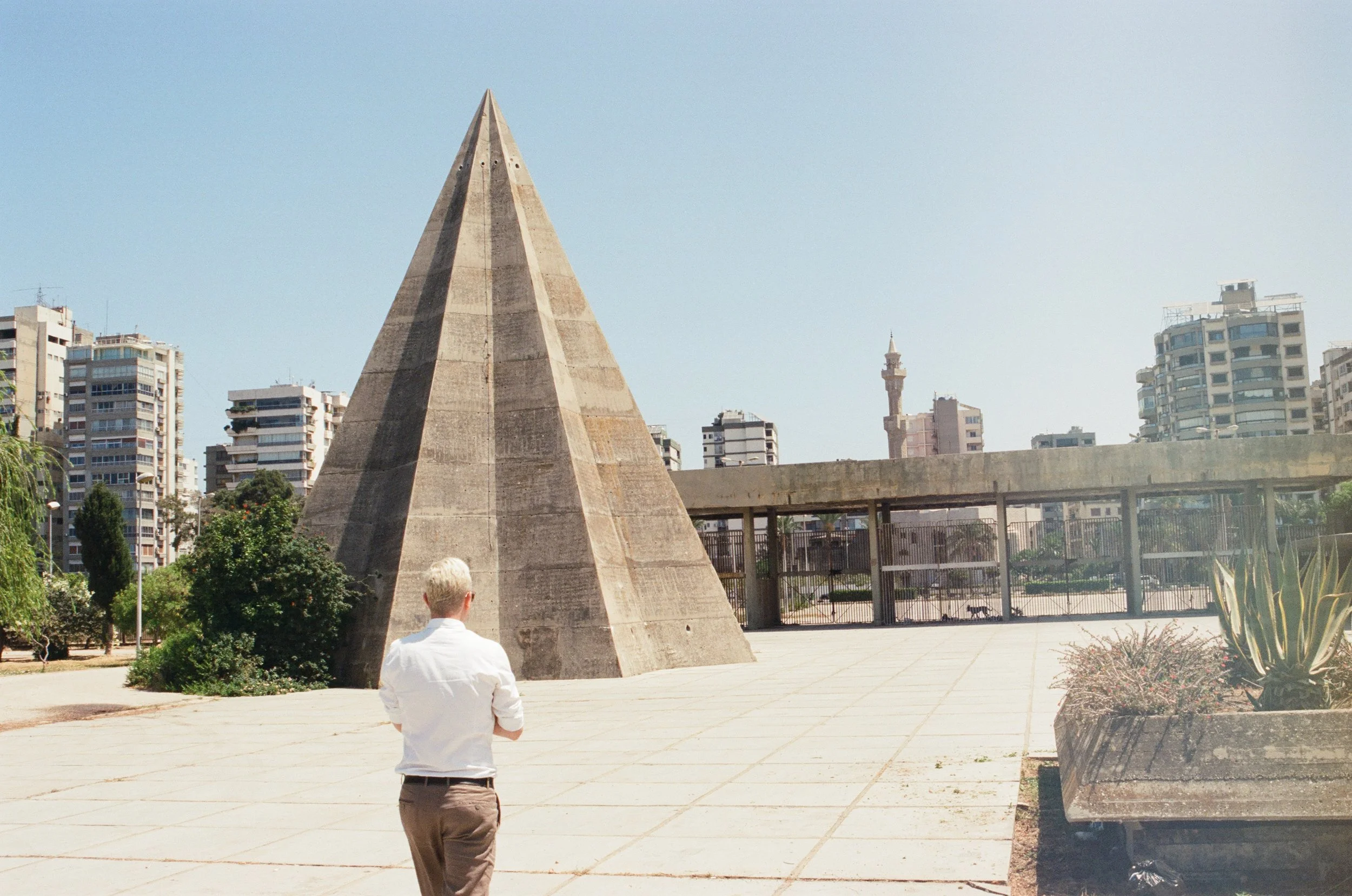
It now consisted in a disconnected 70 hectare elliptic site including a boomerang shaped Exhibition Pavilion, an experimental Dome Theatre, an experimental Theatre and Space Museum, a Lebanese Pavilion and an outside amphitheater.
What remains of the Experimental outdoor Amphitheater.
The experimental Theatre and Space Museum
Because of delays due to lack of funds and political turmoil, the site’s inauguration was pushed back multiple times.
But the major blow to the project came when the Lebanese Civil War broke out in 1975, just as it was completing. Construction was brought to a stop and a year later the site was occupied by Syrian Forces.
The Dome Theatre.
The Israeli occupation of 1982 further paused any possible activity within the site.
It is only in 1995, after the Civil War, that the Fair, named the Rachid Karami (after the late Prime Minister brutal assassination) timidly held small gatherings and exhibitions until the complete withdrawal of military forces from the city in 1998.
So close to completion, it was then left to decay…
Inscribed on the List of World of Heritage in Danger in 2023, today the site exudes modernity and mystery, grandeur and decline.
It is a space full of latent possibilities left for the occasional wanderer to admire.
The Saloua Raouda Choucair Foundation — Safeguarding a Legacy
Opened on July 24, 2024, on what would have marked the artist’s 108th birthday, the Saloua Raouda Choucair Foundation emerges as a quiet national treasure. Nestled within a pine forest in Ras El Metn, an hour from Beirut, the Foundation stands as both sanctuary and archive, safeguarding the vast and visionary oeuvre of Saloua Raouda Choucair— the pioneer of Arab abstract art.
Walking into the Foundation, you’re immediately struck by how prolific, versatile, and cohesive Saloua Raouda Choucair’s work is. There’s a clear vision running through it—an ongoing search that feels both intellectual and deeply personal. Her early love of science, which she studied at the American Junior College of Beirut (now the Lebanese American University), resonates throughout her artistic practice. This scientific curiosity and interest in progress infuses her work with a sense of exploration that spans her entire life.
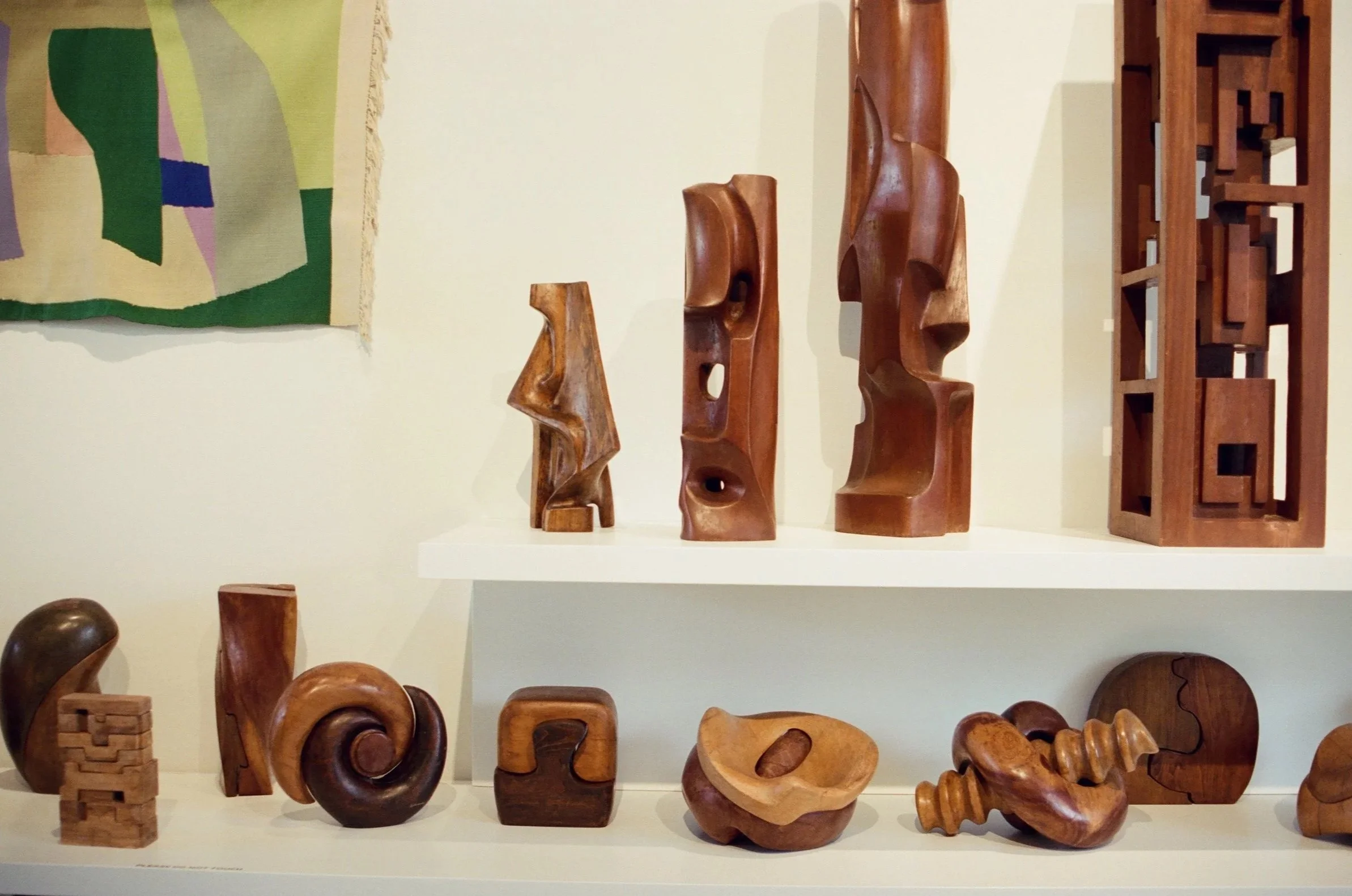
From jewellery designs, illustrations, architectural maquettes, tapestries, paintings, and her signature interlocking sculptures, Saloua Raouda Choucair’s practice was remarkably exploratory and inventive.
She worked across a wide range of materials—marble, polished wood, fired and unfired clay, fiberglass—constantly experimenting with form, structure, and composition.
As Choucair explains in later interviews “all the rules that I apply are derived from the Islamic religion and from Islamic geometric design.”
This foundation helps explain the rational, highly structured nature of her work.
Choucair’s artistic language remained deliberately detached from personal or political narratives; she did not center on themes such as the civil war, motherhood, or domestic life. For Choucair, such subjects were not essential to her artistic enquiry, which instead focused on universal systems, abstraction, and the underlying order of forms.
The artist travelled to Cairo in 1943, and it is where she says she found her vision, roaming the streets and mosques of the city.
She later moved to France and worked in Fernand Léger’s studio where she absorbed more classical painting techniques, though her sculptures developed in an entirely different direction.
She wrote in the Al-Abhath academic journal in 1951: “Arab artists did not care to depict visible, concrete reality as perceived by human beings. Rather, in their quest for beauty, they reached into the essence of the subject…The Arabs dealt with the spirit in the abstract. Their art did not need to be associated with any other art form in order to be complete.”
Choucair’s more mature works embody this philosophy. From the 1960s onwards, it becomes clear that she sought to converge poetic composition within her sculptures, drawing inspiration from Sufi philosophy. She conceived her sculptures as poems, composed of verses that could interlock and be reordered in a continual quest for harmony.
Choucair was ahead of her time, and her recognition late to bloom.